
How Peanut Balls and Movement Transform Your Birth Experience
- Samantha Henry
- May 17
- 7 min read
When you imagine childbirth in movies or TV shows, the scene often shows a laboring person lying flat on their back, legs in stirrups, pushing with all their strength. This image has shaped many expectations about birth, but it does not reflect the most effective or comfortable way to bring a baby into the world. In reality, lying flat on your back is one of the least helpful positions for labor.
At Birth and Body Empowerment LLC, we believe that understanding your body and staying active during labor can make a huge difference. Your body is designed to open, and your baby is designed to move through your pelvis. The key to smooth teamwork between you and your baby is movement. This post explores why movement in labor matters and how using a peanut ball can support you, especially if you choose pain relief options like an epidural.

Why Movement in Labor Matters
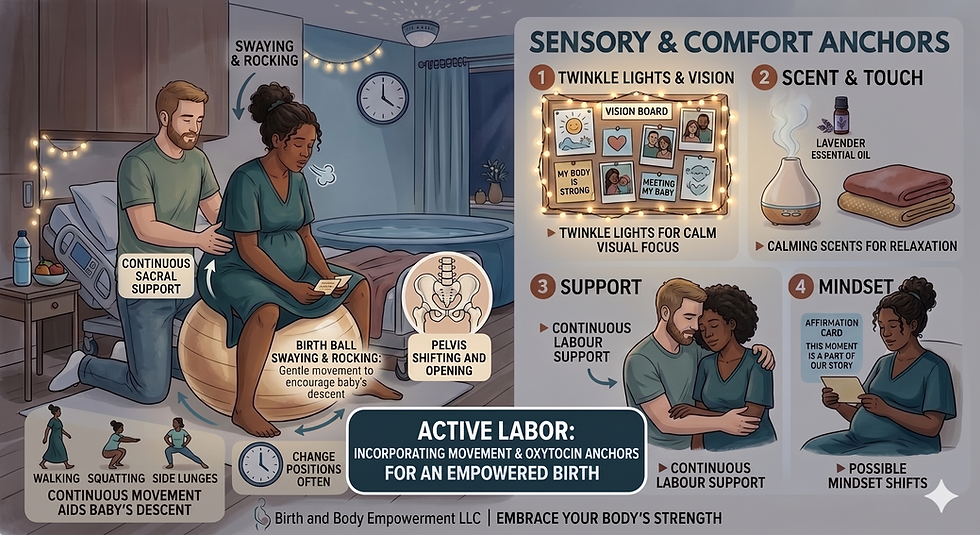
Gravity is a powerful ally during childbirth. When you stay upright and mobile, you help your baby move down through the pelvis. Walking, swaying, lunging, or squatting all encourage your baby to descend and rotate into the best position for birth.
Here are some clear benefits of movement during labor:
Opening the pelvis: The pelvis is not a fixed ring of bone. It consists of joints and ligaments that soften and become more flexible during pregnancy. Moving your hips side to side or changing positions can slightly alter the shape of your pelvic inlet and outlet. This gives your baby more room to navigate the twists and turns needed to be born.
Working with gravity: Standing or sitting upright means the baby’s weight presses directly on the cervix. This pressure helps the cervix dilate more efficiently, speeding up labor.
Managing discomfort: Movement helps your body cope with contractions. Swaying on a birth ball, slow dancing with your partner, or leaning against a wall can reduce the intensity of pain and make labor more manageable than lying still.
Staying active during labor supports an active birth, where you are in control of your body and can respond to what feels best for you.
How Peanut Balls Support Movement in Labor
What happens if you want or need an epidural? Epidurals provide excellent pain relief, but they usually mean you will spend most of your labor lying in bed. This can limit your ability to move and shift positions, which may slow labor or cause discomfort.
This is where the peanut ball becomes a valuable tool. The peanut ball is a peanut-shaped inflatable cushion designed to fit between your legs while you lie on your side. It helps open your pelvis and encourages your baby to move down, even when you cannot get out of bed. In fact, prescriptive use of a peanut ball has been shown to shorten the second stage of labor (pushing) by an average of 11 minutes and significantly reduce C-section rates.
The Biomechanical Choice: Active Mobility vs. Prescriptive Positioning
Labor Element | Upright Mobility (Active Labor Phase) | Prescriptive Peanut Ball Use (Passive/Epidural Support) |
Primary Clinical Goal | Utilizes gravity to encourage progressive baby descent. | Mechanically alters the pelvic inlets, mid-pelvis, or outlets based on fetal station. |
Hormonal Driving Force | Activates the Parasympathetic Nervous System ("Rest & Digest") to foster high oxytocin flow. | Mitigates the "Labor Killer" (Adrenaline) by providing physical rest and structural safety. |
Pelvic Level 1: Inlet (Stations -3 to -1) | Walking, swaying, or asymmetrical lunges to encourage initial engagement. | External Rotation via the "Flying Cowgirl" position (knee higher than hip) to expand the inlet transverse diameter. |
Pelvic Level 2: Mid-Pelvis (Station 0) | Hands and Knees (All-Fours) or pelvic jiggling ("Shake the Apples") to pull the baby's back away from the spine. | Asymmetrical Alignment using modified side-lying positions to lengthen pelvic floor muscles and resolve asynclitism. |
Pelvic Level 3: Outlet (Stations +1 to +3) | Squatting or leaning forward to allow the sacrum to swing back into nutation. | Internal Rotation (knees closed, feet wide/ankles over ball) to flare the Ischial Tuberosities (Sitz Bones) outward. |
Proven Clinical Outcome | Decreases the duration of the second stage of labor and reduces instrumental deliveries. | Shortens the first stage of labor by ~53 minutes and drops C-section rates down to 10%. |

Exploring Peanut Ball Positions
Using the peanut ball is simple, but there are several positions that can maximize its benefits. Here are some common peanut ball positions to try during labor:
Side-Lying Flying Cowgirl (Pelvic Level 1: Inlet Target): Lying on your side with your top leg supported by the peanut ball, the knee is deliberately placed higher than the hip with the foot tucked behind. This external rotation pulls the iliac crests apart, expanding the top of the pelvis to help a high baby engage.
Side-Lying Parallel (Pelvic Level 2: Mid-Pelvis Target): Lying on your side with the peanut ball placed between your thighs and calves, your knees and ankles are kept entirely parallel. This symmetrical alignment opens the "Zone of Rotation" at the level of the ischial spines (Station 0). It lengthens the pelvic floor muscles and releases soft tissue, providing the exact lateral space needed to resolve left or right asynclitism and give a tilted head room to square up.
Side-Lying Internal Rotation (Pelvic Level 3: Outlet Target): Lying comfortably on your side with your knees kept completely together, the peanut ball is specifically positioned further down between your feet or ankles rather than your knees. This alignment forces internal rotation, giving the baby maximum space to pass through the pelvic floor.
Each position encourages gentle movement in labor, even when you are limited to bed rest. Your care team can help you find the best peanut ball position for your comfort and progress.
Combining Movement and Peanut Ball Use for an Active Birth
Active birth means you are engaged and moving during labor, using your body’s natural abilities to help your baby be born. Even if you choose an epidural, you can still have an active birth by using tools like the peanut ball.
Here are some tips to combine movement and peanut ball labor effectively:
Change positions regularly: Switch between side-lying, semi-reclined, and sitting positions with the peanut ball to keep your pelvis moving. Shifting every 30 to 45 minutes keeps the pelvic space dynamic!
Sway and rock when possible: If you can sit up or lean forward, gently sway your hips or rock your pelvis to encourage the baby’s descent.
Use breathing and relaxation techniques: Movement works best when combined with deep breathing and relaxation to reduce physical tension.
Communicate with your care team: Ask for help adjusting the peanut ball or trying new positions. Your team can support your movement goals.
Your Journey, Your Power
Movement in labor and the use of a peanut ball can transform your birth experience. Staying active helps open your pelvis, supports baby’s descent, and manages discomfort. The peanut ball offers a practical way to keep your hips open and encourage progress, especially if you choose an epidural or need to stay in bed.
Understanding these tools gives you more control and confidence in the birthing room. Talk with your care provider about how you can incorporate movement and peanut ball positions into your birth plan. Your body and baby are ready for this journey—movement is the key to making it smoother and more comfortable.
Ready to Stay Empowered Throughout Your Pregnancy and Birth?
At Birth and Body Empowerment LLC, we don’t just share the tools—we train you, your family, and care teams to use them precisely. Whether you are looking for evidence-based childbirth education, trauma-informed care strategies, or deep biomechanical preparation to help you navigate your labor with true autonomy, we are here to support your journey.
Here is how you can stay connected with us and dive deeper into your birth empowerment:
📱 Follow Us on Social Media: Join our community on Instagram and Facebook for daily tips, labor position reels, birth inspiration, and a supportive network of expectant parents.
💌 Join Our Newsletter: Sign up for our weekly newsletter to get evidence-based birth resources, clinical insights, and updates delivered straight to your inbox.
👥 Explore Our Services: Ready to build your dream birth team? https://www.birthandbodyempowerment.com/ and see how we can work together!
🎁 Coming Soon! We are currently putting the finishing touches on our exclusive BBE Labor Positions & Pelvic Level Cheat Sheet. Newsletter subscribers will be the very first to get access, so be sure to sign up today to download it as soon as it drops!
Resources
Primary Biomechanical & Clinical Research
Delgado-García, et al. (2025): "Effects of peanut ball during labor" – This study validates the prescriptive use of peanut balls for patients with epidurals, specifically documenting the approximate 53-minute reduction in the first stage of labor.
Lawrence, A., et al. (2025): "Maternal positions & mobility" – Recognized as a gold-standard study evaluating upright maternal positioning, mobility, and their direct correlation to reduced Cesarean delivery rates.
Gül, A., et al. (2024): "Vertical positions and movement" – Explores the mechanics of vertical positioning, pelvic symmetry, and pelvic outlet opening during the final stages of descent.
National Obstetric Guidelines & Consensus Documents
American College of Obstetricians and Gynecologists (ACOG) Clinical Consensus No. 1 (2014): "Safe Prevention of the Primary Cesarean Delivery" – A foundational, peer-reviewed document challenging the rigid timeline of the traditional Friedman Curve. It explicitly suggests that slow labor progress alone is not a sole indication for a C-section and supports giving laboring individuals more time to progress safely.
ACOG Committee Opinion No. 766 (2019): "Approaches to Limit Intervention During Labor and Birth" – Strongly supports the integration of non-pharmacological pain management techniques, continuous labor support, and position changes to protect the physiological birth process.
ACOG Clinical Practice Guideline No. 8 (2024): Evaluating labor progression markers and establishing updated parameters to safely define active labor phases, which helps prevent premature diagnoses of labor arrest.
Autonomy & Support Frameworks
Breman, R. B., et al. (2024): "Shared Decision Making in Perinatal Care" – Provides the clinical framework for utilizing tools like the B.R.A.I.N. communication model and labor menus to bridge the gap between clients and hospital care teams.
Thompson, S., et al. (2023): "The Impact of Autonomy on Outcomes" – Connects high maternal autonomy and collaborative care directly to lower rates of secondary birth trauma and postpartum hemorrhage.
Disclaimer: The information provided on this blog by Birth and Body Empowerment LLC is for educational and informational purposes only. It is not intended to be a substitute for professional medical advice, diagnosis, or treatment. Always seek the advice of your physician or other qualified healthcare provider with any questions you may have regarding a medical condition, pregnancy, or labor plan. Never disregard professional medical advice or delay in seeking it because of something you have read on this website.


Comments