
The Station Story: How Your Baby Navigates the Pelvic Canal (And How to Clear the Way)
- Samantha Henry
- Jul 2
- 5 min read
When we talk about labor progress, everyone asks the exact same question: “How many centimeters are you?” It’s the gold standard metric in pop culture and hospital corridors alike. But as a nationally certified labor and delivery nurse, I’m going to let you in on a clinical secret: dilation is only half the story. Your cervix can be completely wide open, but if your baby hasn’t successfully navigated the bones of your pelvis, birth doesn’t happen. When your provider or nurse performs a cervical check, they aren’t just feeling for a ring of stretching tissue. They are measuring a complex, three-dimensional spatial relationship called station.
If you’ve ever felt defeated because your dilation number didn't change after hours of hard work, it’s time to reframe the narrative. Your body wasn't failing; your baby was likely just working through a beautiful, hidden anatomical puzzle. Let’s demystify the physics of descent.

The Canal and the Checkpoint: What is "Station"?
To make sense of station, let’s step away from medical jargon and use a real-world metaphor.
Imagine your labor not as a ticking clock, but as a journey. Your pelvis is a winding, structural canal, and your baby is a ship trying to navigate through it to reach the ocean.
The canal isn't a perfectly straight, wide-open slide. It has varying depths, angles, and one incredibly tight, specific internal checkpoint. In the medical world, we call this checkpoint the ischial spines—two small, inward-facing bony points at the narrowest mid-plane of your pelvis.
Think of these spines as a strict shipping lock. How your baby relates to that checkpoint determines their "station," measured on a numerical grid from −3 to +3:
Negative Station (−3 to −1): The ship is still out in the deep water, floating high above the checkpoint.
Zero Station (0): Engagement! The widest part of your baby’s head has successfully entered the shipping lock. This is a massive milestone. It means the ship fits.
Positive Station (+1 to +3): The ship has cleared the tightest bottleneck and is actively gliding down the final stretch of the canal toward your arms.

The Twisting Dance: Why It’s Not a Straight Drop
If the pelvic canal were a straight vertical tube, babies would simply drop down like an elevator. But human anatomy is far more brilliant than that.
The entrance to your pelvis (the inlet) is widest from side-to-side. However, the outlet of your pelvis (the opening) is widest from front to back.
This means your baby cannot just sail straight through. To navigate the canal safely, the ship has to execute a series of highly coordinated maneuvers. They must tuck their bow (tucking their chin tightly to their chest to present the smallest diameter of their skull) and rotate their entire hull sideways, then forward again, to wiggle past those bony landmarks.
When your labor seems to "stall" at a 5 or 6 centimeter mark, the ship is usually just actively steering around a tight corner. It takes immense physical work, uterine contractions, and time for the baby to mold their skull bones and rotate past the ischial spines. Progress is happening—even when the dilation chart stays flat.
Steering the Ship: How Movement Changes the Canal
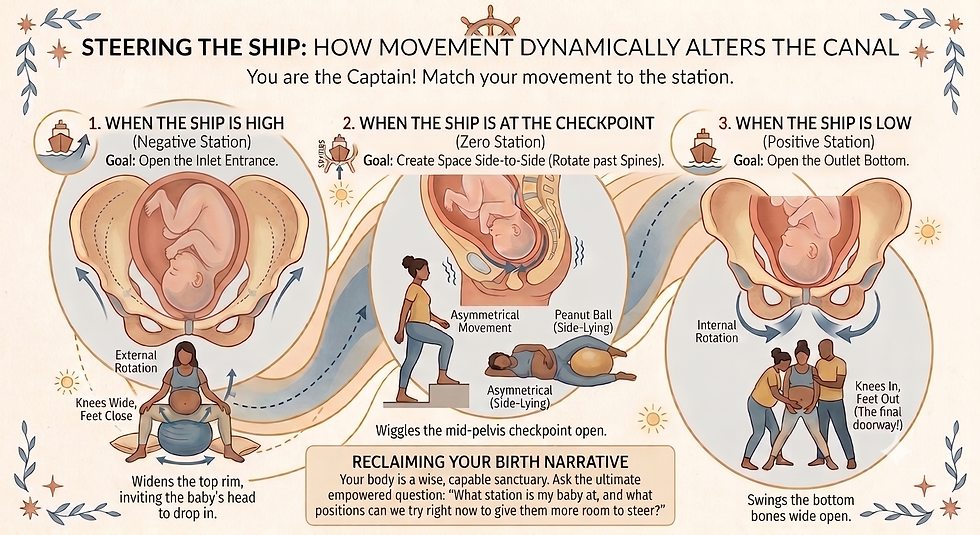
As the birthing person, you are not a passive bystander watching the ship struggle. You are the captain, and your movement can dynamically alter the canal's shape to clear the baby's path.
Because different stations correlate to different levels of the pelvis, your movement strategies should change depending on where the ship currently is:
1. When the Ship is High (Negative Station)
The Goal: You need to open the entrance (inlet) of the pelvic canal.
The Movement: Focus on external rotation of the hips. Think knees wide, feet close together. Gentle squatted positions, sitting on a birth ball, or butterfly stretches physically widen the top rim of your pelvis, inviting the baby's head to drop in.
2. When the Ship is at the Checkpoint (Zero Station)
The Goal: You need to create space side-to-side right in the middle of the pelvis to help the baby rotate past the ischial spines.
The Movement: Asymmetrical movement is king here. Walking up and down stairs, curb walking, or lunging shifts the pelvic bones back and forth, wiggling the checkpoint open. If you have an epidural, this is the prime time to use advanced positioning with a peanut ball in a side-lying position to dynamically alter the mid-pelvic diameter.
3. When the Ship is Low (Positive Station)
The Goal: The baby has cleared the spines and is ready to exit! You need to open the bottom (outlet) of the pelvis.
The Movement: This requires internal rotation of the hips—knees in, feet out. It sounds completely counterintuitive, but knocking your knees together and pushing your ankles outward physically swings the bottom of your pelvic bones wide open, clearing the final doorway for birth.
Reclaiming Your Birth Narrative
The next time you are in labor and your provider gives you a cervical check, don't let your mind get trapped by a single number. If they shout out a string of clinical code like "5 centimeters, 90% effaced, minus two," you now have the map to understand exactly what that means.
It means your baby is safely navigating the upper canal, getting into position to meet the checkpoint. Your body is a wise, capable sanctuary, and your baby is an active, brilliant participant in this journey.
Instead of asking, "How much longer?" look at your labor nurse and ask the ultimate empowered question:
"What station is my baby at, and what positions can we try right now to give them more room to steer?"
References
American College of Obstetricians and Gynecologists (ACOG). (2019). Approaches to limit intervention during labor and birth. Committee Opinion No. 766. Obstetrics & Gynecology, 133(2), e164-e173.
Association of Women's Health, Obstetric and Neonatal Nurses (AWHONN). (2020). Fetal Heart Monitoring Principles and Practices (6th ed.). Washington, DC: AWHONN. (Supports advanced nursing evaluation of spatial relationships, fetal positioning, and labor assessments).
Desseauve, D., Fradet, L., Lacouture, P., & Pierre, F. (2019). Is maternal posture during labor influenced by pelvic biomechanics? A systematic review. European Journal of Obstetrics & Gynecology and Reproductive Biology, 236, 149-157.
Gizzo, S., Di Gangi, S., Noventa, M., Bacconnier, R., Saccardi, C., Gangemi, M., & D'Antona, D. (2014). Women's choice of positions during labor: Return to the past or a progressive future? BioMed Research International, 2014, 1-7. (Provides evidence on how asymmetrical movement alters internal pelvic diameters).
Lowdermilk, D. L., Perry, S. E., Cashion, M. C., Alden, K. R., & Olshansky, E. F. (2023). Maternity and Women's Health Care (12th ed.). Elsevier. (Clinical textbook verification for the definitions of fetal station, engagement, and the cardinal movements of labor).
Premier Birth Tools. (n.d.). The Peanut Ball Primer: Evidence-based research for the use of the peanut ball in labor. Retrieved from premierbirthtools.com (Direct reference validating your certified training curriculum regarding positioning relative to pelvic planes).
Simkin, P., & Ancheta, R. (2023). The Labor Progress Handbook: Early interventions to prevent and treat dystocia (5th ed.). Wiley-Blackwell. (The foundational industry text for utilizing internal and external hip rotation to open the pelvic inlet, mid-pelvis, and outlet).
Tussey, C. M., Botsios, E., Gerkin, R. D., Kelly, L. A., & Shornick, J. (2015). Reducing length of labor and cesarean surgery rate in nulliparous women utilizing the peanut ball: A retrospective study. The Journal of Perinatal Education, 24(1), 16-24.



Comments